
 Top Websites in the World — 2026 Global Highlights
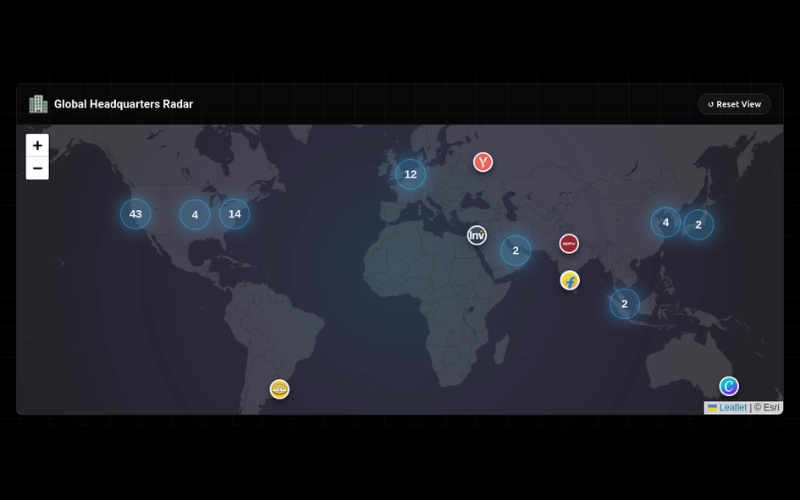
 Global Headquarters Radar
 Top 10 Search Engines









 Top 10 Streaming








 Top 10 Social Media









 Top 10 News









 Top 10 eCommerce









 Top 10 Finance









 Top 10 Tech








 Top 10 Gaming









 Top 10 Other









A Simple Guide to the Top Websites in the World
 Directory Guide Table of Contents
Navigate this comprehensive analysis of global web traffic, directory features, and data-aggregation methodologies.
- Introduction: Mapping the Digital Territory
- 1. How to Use this Directory and Visual Tools
- 2. Tracking the Highest Traffic Websites in the World
- 3. The Most Popular Search Engines Globally Today
- 4. Top Social Media Websites by Traffic We Use Every Day
- 5. Top Ecommerce Websites in the World for Online Shopping
- 6. Checking the Most Visited AI Websites Right Now
- 7. Most Visited News Websites and Reference Portals
- 8. Shifting Patterns on the Global Web Traffic Leaderboards
- 9. FAQ: Details on the Top Websites in the World
- 10. Summary: The Servers Behind the Screen
- 11. Final Thoughts: What Lies Ahead for Global Traffic
If you want to know what the top websites in the world are, you are in the right spot. We made this site to make it super easy for you to see where everyone hangs out online. This is not just a dry database; it is an active directory tracking the biggest names on the web in real-time. Whether you are looking for tech giants, social networks, or retail hubs, we have compiled the metrics clearly. Our goal is to make these numbers easy to digest for everyday users and search crawlers alike. The internet changes every single day, but this tracker is built to keep you completely up to speed.
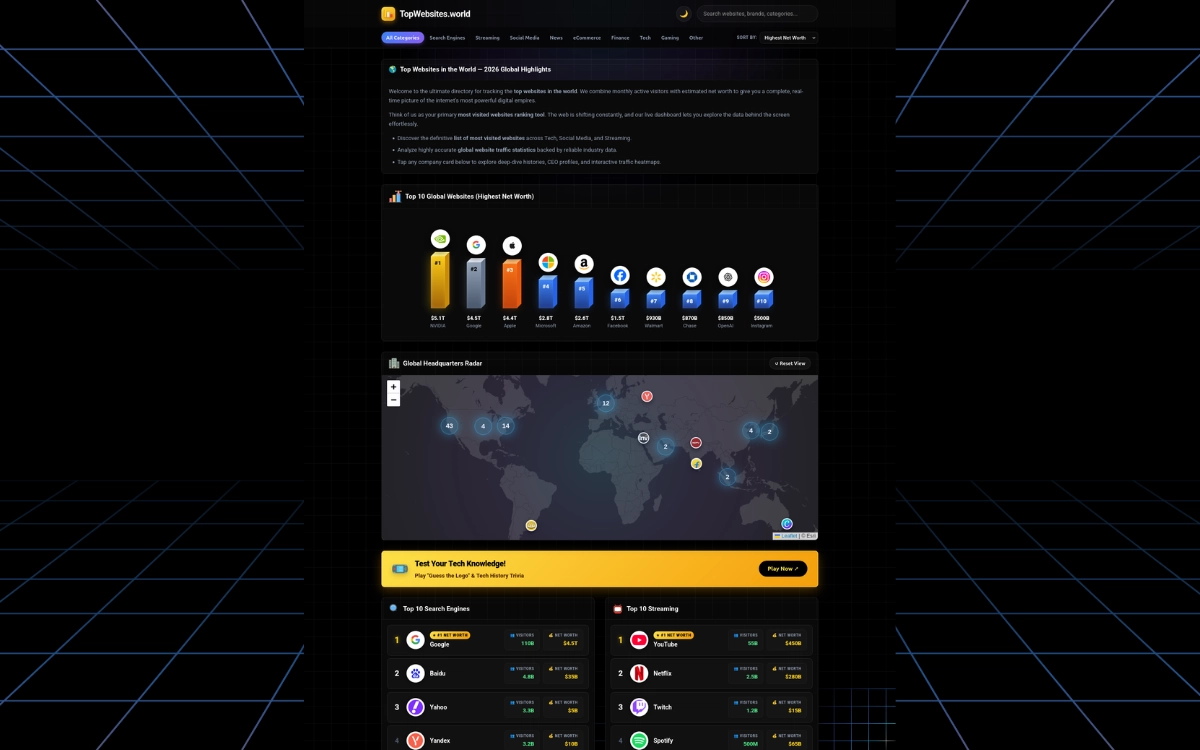
This guide contains a helpful list of most visited websites along with details on how to navigate our dashboard. Before you dive into our deep analytics, take a look at the Table of Contents right above. It is laid out in a single vertical column so you can jump straight to any section you care about. We will cover search engines, social media, shopping hubs, AI tools, and news sites. Our directory also includes cool tools like a 3D valuation graph and an interactive map showing corporate headquarters. We designed this to be a quick, casual read that tells you exactly what you need to know without any boring jargon.
Core Features of Our Global Web Directory
 Real-Time Traffic Data
Track exact monthly active visitors sourced from premium analytics tools to see exactly where the world spends its time online.
 Net Worth Valuations
We calculate the estimated market capitalization of the parent companies behind the top websites in the world.
 Global Heatmaps
Discover exactly which countries drive the most engagement to the highest traffic websites in the world with interactive maps.
 Executive Profiles
Get to know the CEOs, founders, and corporate leaders who actively control the internet's most powerful digital empires.
 Interactive Quizzes
Test your knowledge of tech history and internet culture with our custom-built "Guess the Logo" games and trivia.
 Mobile Optimized
A fast, responsive dashboard designed to deliver global website traffic statistics on any phone, tablet, or desktop.
1. How to Use this Directory and Visual Tools
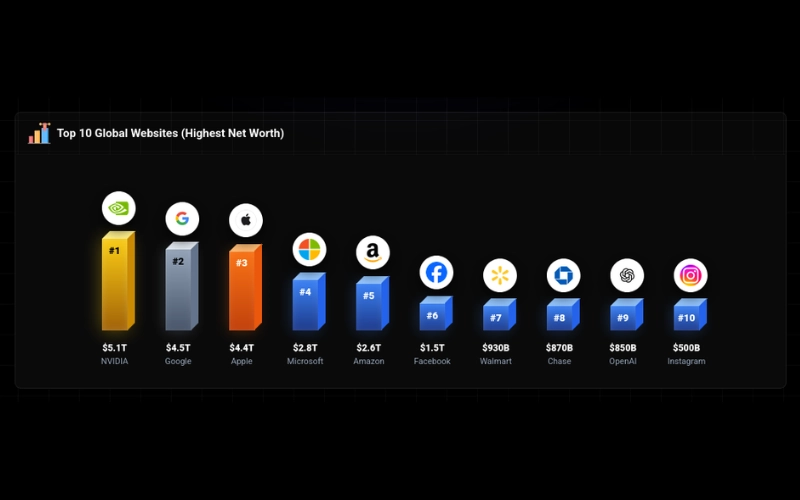
When you use our most visited websites ranking tool, you get to play with some really cool interactive features. First, check out the 3D Graph at the top of the homepage. It shows you the net worth of giant companies like NVIDIA, Google, and Microsoft. Seeing those massive billion-dollar blocks side-by-side really puts their financial power into perspective. Next, scroll down to the Global Headquarters Radar Map. It uses Leaflet to show you exactly where these tech empires are physically located. It is fun to zoom in and see how many of them are clustered in places like Silicon Valley or Seattle.
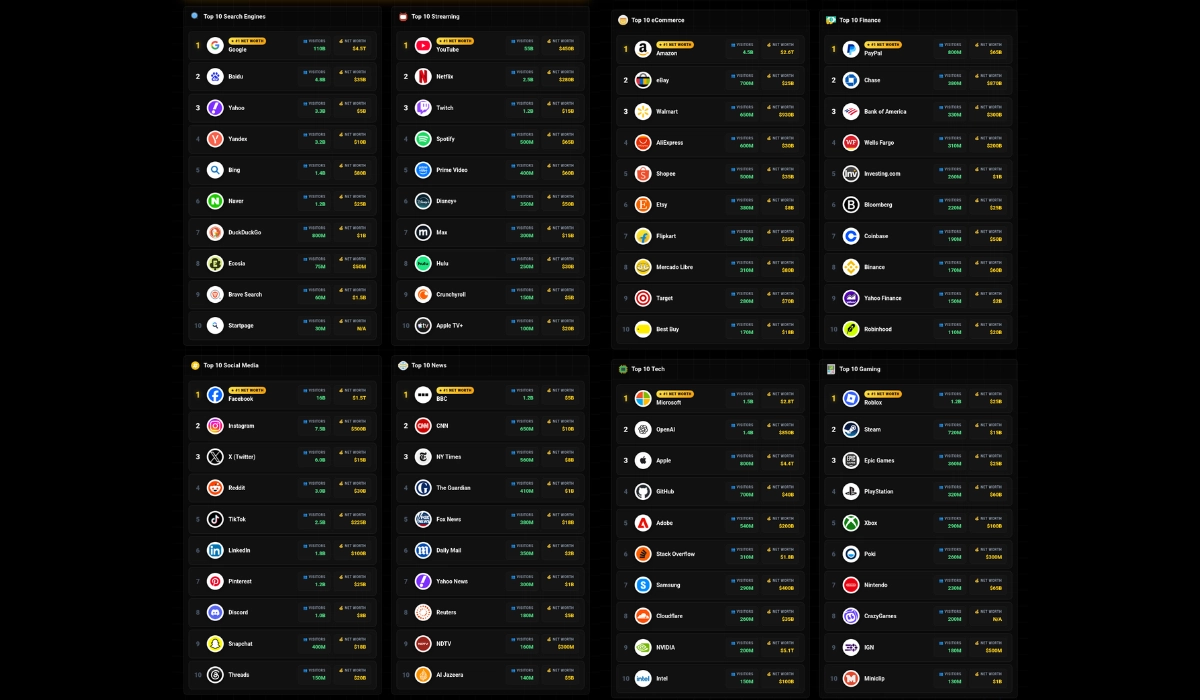
We also track the top websites by monthly visits inside clean, separate leaderboard cards. If you look at the columns for Search Engines and Streaming, you will see exactly how many active users log in every month. We also put a yellow Tech Trivia banner right in the middle of the page. You can click it to play a fun game where you guess company logos and answer tech history questions. It is a great way to test your internet knowledge. Below all these tools is where our big global directory analysis starts, explaining the trends behind these platforms.
- Compare Traffic: Use our active directory cards to compare monthly active visitors instantly.
- View Corporate Worth: Spin the 3D Bar Graph to visualize the massive valuations of parent entities.
- Locate Tech Hubs: Zoom in on the clustered Leaflet map to pinpoint corporate offices globally.
- Play Trivia Games: Tap the bright yellow bento card to test your logo and history knowledge.
- Filter by Category: Click on any category pill to instantly isolate the brands you care about.
2. Tracking the Highest Traffic Websites in the World
Finding out which are the highest traffic websites in the world takes a lot of hard work behind the scenes. We do not just guess these numbers. Our system looks at first-party data, server logs, and anonymized user panels. Then we cross-reference everything to make sure bot traffic and web scrapers are filtered out. This means the numbers you see on our cards are highly accurate and reflect real human behavior. We wanted to build a dashboard that gives you the real story of online attention, showing you who is truly winning the battle for our screens.
If you compare different global website traffic statistics online, you might notice some differences here and there. This happens because platforms track metrics differently. For instance, a similarweb top websites global report focuses heavily on browser extension panels. On the other side, a most visited websites ranking semrush update might look more at search engine results pages and organic search clicks. To solve this, we blend these data streams together. This gives you a balanced view that matches what is actually happening in the real world of internet browsing.
Keeping up with the most popular websites globally requires a massive physical network of undersea cables and server farms. According to the International Telecommunication Union (ITU), fixed broadband data use has skyrocketed to over 7,300 exabytes [1.2.1]. Mobile data usage is also huge, passing 1,500 exabytes [1.2.1]. Every time you stream a video or search for a recipe, you are sending data through these systems. The top platforms on our list require billions of dollars in hardware to keep their systems running without crashing, proving that digital power is built on physical infrastructure.
- Clean User Telemetry: We active-filter automated scrapers and bot nets to protect data integrity.
- ISP Direct Integration: Aggregated broadband feeds help us track data consumption peaks.
- Balanced Measurements: Our system balances clickstream panel logs with index search calculations.
- Undersea Fiber Networks: Subsea telecom lines carry 99% of global internet traffic to serve these sites.
- Continuous Synced Data: Leaderboard figures update continuously to reflect real-world server loads.
3. The Most Popular Search Engines Globally Today
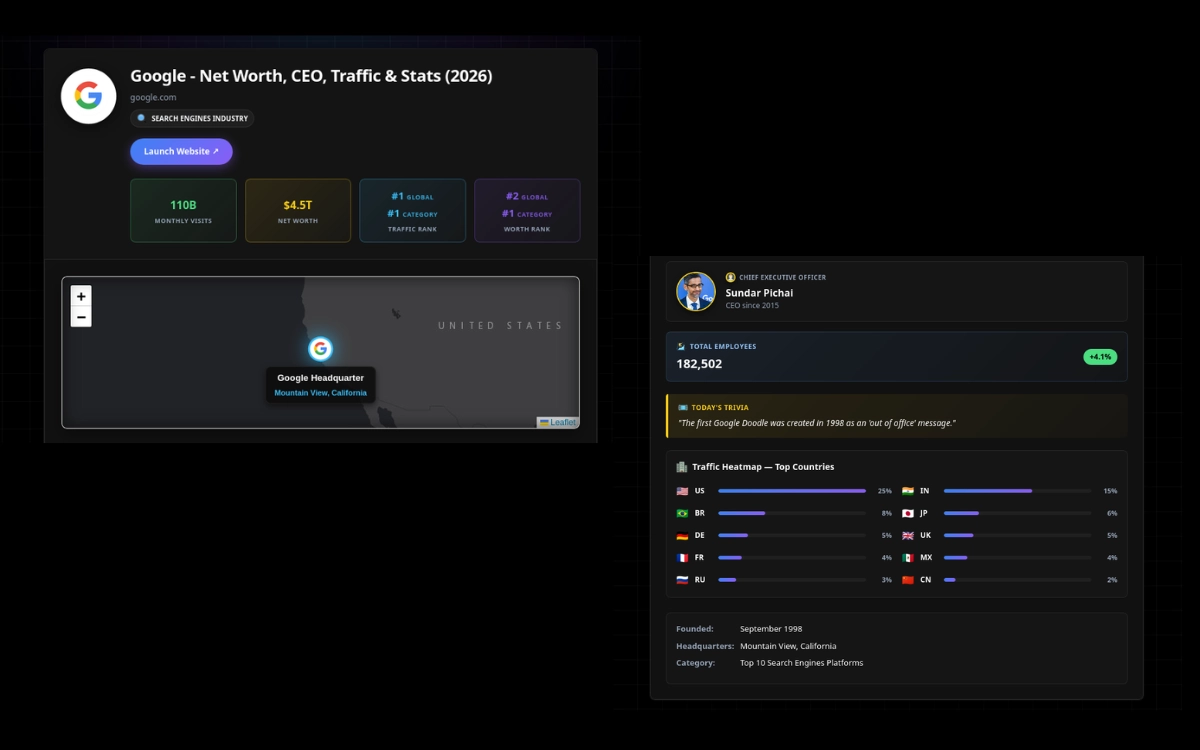
When we look at the most popular search engines globally, Google is still the undisputed king. It easily sits at the very peak of the top ten websites in the world, processing billions of questions every single day. Google has become a basic utility, like electricity or running water, that we use to navigate our daily lives. But the search landscape is starting to shift in a big way. Microsoft Bing has grown steadily by adding smart AI features to its search bar, making it a super helpful option for desktop users who want instant answers.
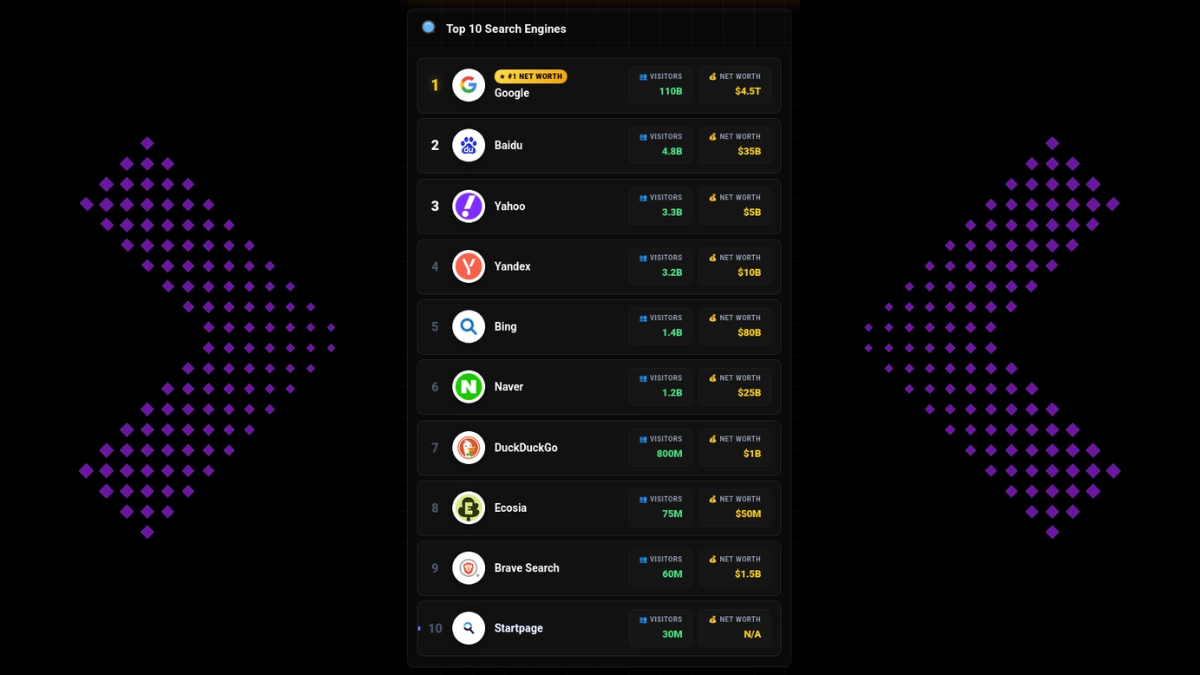
If you look at the website traffic ranking global charts, you will see that different countries prefer different search tools. For example, Baidu is the absolute leader in China because of local language optimization and specific regional rules. In Russia and nearby countries, Yandex is the main homepage people use every day. Over in Japan, Yahoo Japan is still a massive portal where millions go for search, news, and shopping. These regional preferences show that the internet is not a single monopoly, but rather a collection of local networks.
- Search Engine Dominance: Google processes over 90% of global queries, maintaining its #1 title.
- Desktop AI Integration: Bing captures more desktop users thanks to smart chat tools.
- Local Language Optimization: Baidu navigates regional compliance rules to dominate East Asian traffic.
- Multi-Service Local Portals: Yandex operates local mapping, search, and home utility portals.
- Alternative Option Growth: DuckDuckGo expands as more users demand tracker-free searching options.
5. Top Ecommerce Websites in the World for Online Shopping
Let us switch gears to the top ecommerce websites in the world and how they changed shopping forever. In North America and Europe, Amazon is the giant that everyone uses. Its fast shipping and massive catalog made physical retail stores struggle to keep up. But just like search engines, online shopping looks totally different depending on where you live. In Latin America, Mercado Libre is the king, while Shopee rules Southeast Asia. These companies succeeded by tailoring their apps to local payment habits and regional logistics networks.
If you look at the similarweb top websites global e-commerce rankings, you will also see massive cross-border players. AliExpress continues to connect bargain hunters directly to factories in China, bypassing local middlemen to offer rock-bottom prices. At the same time, Temu has taken the world by storm with incredibly cheap prices and massive ad campaigns that have made it a household name overnight. These platforms prove that global supply chains have made it easier than ever to ship products directly to your doorstep from across the globe.
- Prime Shipping Network: Fast delivery and unified cloud services make Amazon the Western retail leader.
- Integrated Financial Wallets: Mercado Libre relies on integrated wallet services to secure local transactions.
- Southeast Asian Growth: Shopee captures mobile shopping traffic through gamified app rewards.
- Factory-to-Consumer Channels: AliExpress connects global buyers straight to East Asian factory floors.
- Gamified Customer Growth: Temu uses gamified mobile features to scale its global logistics footprint.
6. Checking the Most Visited AI Websites Right Now
Now, we have to look at the most visited ai websites because they are changing everything. Artificial intelligence has gone from a sci-fi dream to a tool we use every single day to write emails, build code, and create art. OpenAI's ChatGPT is leading this charge, pulling in billions of monthly visits faster than any other platform in internet history. It has completely disrupted how we look at search, as users can now have a back-and-forth conversation with a computer instead of clicking on blue links.
This AI revolution has forced the most visited websites in the world to adapt or risk being left behind. Google launched its Gemini model to protect its search engine, while Anthropic's Claude has become a favorite for writing long, complex documents and coding. We also see Perplexity AI rising fast by combining search with conversational answers. These tools require a massive amount of computer processing power, which is why companies like NVIDIA have seen their valuations explode to trillions of dollars as they build the chips powering these models.
- Conversational Chat Leaders: ChatGPT expanded to billions of visits faster than traditional social networks.
- Search Traffic Shifts: Conversational answers reduce user reliance on classic search listings.
- High-Context Analysis: Claude has become a primary utility for complex coding and document reviews.
- Dynamic Live Summaries: Perplexity indexes live web results and structures them into casual summaries.
- Hardware Infrastructure Power: AI platforms demand immense cloud server setups to handle complex tasks.
7. Most Visited News Websites and Reference Portals
When major events happen, the most visited news websites see massive spikes in traffic as people rush to find out what is going on. Outlets like the BBC, CNN, and the New York Times are the primary destinations for real-time reporting during elections, natural disasters, or major policy shifts. People trust these established brands to cut through the noise and rumors on social media. Managing these massive traffic spikes requires incredibly robust web hosting systems to keep the sites from crashing when millions of users visit at once.
If you look at the wikipedia most visited websites list, you will realize that crowdsourced, ad-free knowledge is still incredibly popular. Wikipedia is one of the very few non-commercial, non-profit sites to remain at the top of the global web. Run by the Wikimedia Foundation and edited by a global network of volunteers, it serves as the ultimate school library for billions of students, researchers, and curious minds. It proves that the original dream of a free, open, and collaborative internet is still thriving.
- The BBC (bbc.com): Serves as a primary public broadcasting portal, driving reliable global traffic with no commercial bias.
- CNN (cnn.com): Commands massive live visual traffic during breaking geopolitical and weather-related events.
- The New York Times (nytimes.com): Successfully monetizes high-utility digital subscriptions alongside core editorial reporting.
- Wikimedia Foundation: Keeps Wikipedia running globally on consumer donations, preserving an ad-free user interface.
- CDN Distribution Scales: News platforms rely on CDN distribution lines to handle massive concurrent visitor peaks safely.
8. Shifting Patterns on the Global Web Traffic Leaderboards
Geography plays a huge role in the global web traffic leaderboards, as the internet is not the same everywhere. The Asia-Pacific region is the single largest digital block, accounting for over half of all global network traffic [1.2.1]. Because of local languages, cultural habits, and national policies, regional platforms often completely replace Western giants in these markets. As fast 5G mobile networks continue to expand in Southern Asia, millions of new users are coming online every year, constantly shifting the global balance of power and traffic rankings.
- Asia-Pacific Traffic Peak: East and South Asian countries generate over 50% of the world's web traffic.
- WeChat Local Ecosystems: Local Chinese messaging networks handle everything from daily banking to taxi bookings.
- 5G Expansion Speeds: South Asian countries bring millions of mobile-only internet users online annually.
- Language Curation Trends: National compliance boundaries naturally restrict Western platform expansions.
- Global Infrastructure Moves: Server farms are expanding heavily in developing nations to support local networks.
9. FAQ: Details on the Top Websites in the World
Checking out the facts regarding the top ten websites in the world is super simple with our consolidated guide below.

- Visual Dashboards: Compare monthly active visitor numbers across different industry sectors easily.
- Aggregated Data: Learn how we blend clickstream logs and search calculations for precise insights.
- Geographic Powerhouses: Discover why regional retail and search tools command massive traffic shares.
- Wikipedia's Ad-Free Model: See why Wikipedia stands tall as the main ad-free reference site globally.
- Generative AI Platforms: Track how AI tools are scaling their visitor footprints faster than ever before.
1. What are the top websites in the world right now?
Currently, the top websites in the world are heavily dominated by search and social media giants. Google, YouTube, and Facebook consistently top the list of most visited websites, pulling in billions of active users every single month. These platforms function as primary consumer portals and utility layers for global internet navigation.
2. How to check top websites in the world for accurate traffic?
If you're wondering how to check top websites in the world without clicking through raw spreadsheets, our platform acts as the ultimate most visited websites ranking tool. We aggregate global website traffic statistics to keep you updated instantly, resolving discrepancies by correlating direct-measurement data and panel metrics.
3. Which are the top ecommerce websites in the world?
When looking at top websites by monthly visits in retail, Amazon is the undisputed leader in Western markets. However, the top ecommerce websites in the world also feature massive regional leaders like AliExpress, Shopee, and Mercado Libre climbing the global web traffic leaderboards, catering to diverse local demographics.
4. What are the most visited AI websites today?
The tech landscape is shifting at lightspeed. The most visited ai websites prominently feature OpenAI (ChatGPT), which shattered historical records to climb the website traffic ranking global charts, completely changing the similarweb top websites global rankings in just months. Alternative options like Claude and Gemini also drive significant user engagement.
5. How does this compare to the Wikipedia most visited websites list?
While you can certainly read a standard wikipedia most visited websites list, our platform goes much deeper. We combine the highest traffic websites in the world with real-time market caps, interactive heatmaps, and exclusive data on the most visited news websites all in one place!
6. Who tracks the highest traffic websites in the world?
We pull data similar to a similarweb top websites global report and cross-reference it with most visited websites ranking semrush data. This multi-source correlation process helps us ensure our list of the top websites in the world remains statistically grounded and clear of duplicate telemetry.
7. What are the top social media websites by traffic?
Facebook, Instagram, and TikTok lead the top social media websites by traffic. They command massive attention on the website traffic ranking global charts, making them undisputed top websites in the world as they capture the majority of daily active users.
8. Which are the most visited news websites globally?
The BBC, CNN, and The New York Times are consistently the most visited news websites. They easily earn their spot on the list of most visited websites due to massive daily readership during major global events, geopolitical shifts, and political transitions.
9. Are the most popular search engines globally still growing?
Yes. Google is still king, but alternative privacy platforms like DuckDuckGo are rising fast among the most popular search engines globally, proving the top websites in the world are constantly evolving to meet shifting consumer demands for user data protection.
10. How often do the top websites in the world change rankings?
The top websites in the world shift every month. We track the global web traffic leaderboards in real-time so you always know exactly which platforms are the most popular websites globally, capturing new technological developments as they emerge.
10. Summary: The Servers Behind the Screen
Wrapping things up, analyzing the top websites in the world shows us a highly consolidated digital economy. When we study how these systems scale, we see a a clear push toward localized cloud computing and decentralized nodes. To keep page-load times incredibly low, big brands are moving their files closer to your home town using CDN networks. As we watch mobile usage climb, web developers must build simpler, lighter sites that do not drain phone batteries or eat up expensive mobile data plans. The physical reality of the web is always changing, and keeping an eye on these physical systems helps us prepare for the next big wave of internet technology.
- Hyperscale Cloud Centers: Fast processing networks power our everyday online transactions.
- Edge CDN Support: Placing files closer to local regions speeds up loading times.
- Energy Grid Demands: Growing tech centers consume significant power resources globally.
- Platform Consolidation: A select few conglomerates hold major shares of global attention.
- Technical Maintenance: Massive hardware setups are required to prevent regional blackouts.
11. Final Thoughts: What Lies Ahead for Global Traffic
Looking ahead, keeping track of the top websites by monthly visits is essential for understanding where the internet is heading. The next decade is going to be all about how traditional websites merge with active mobile apps and AI partners. We are already seeing a major change in how everyday people search for information, with many choosing to chat with a bot instead of browsing a list of links. At the same time, governments are passing new rules about where consumer data can be stored, which will force companies to build local databases in different countries. Staying on top of these massive shifts means keeping a close eye on the numbers and seeing which platforms can adapt the fastest. Make sure to bookmark our dashboard so you can watch these global trends play out month by month.
- AI Search Integration: Watch how virtual chat partners change classic navigational pathways.
- App Browser Shifts: Mobile app systems continue to absorb traditional desktop traffic.
- Data Localization Laws: Regional rules alter how user browser actions are logged and stored.
- Developing Market Waves: New mobile users continuously change global leaderboard balances.
- Real-Time Curation: Keep exploring our maps and charts to watch the digital world grow.
4. Top Social Media Websites by Traffic We Use Every Day
Next, let us talk about the top social media websites by traffic and how they keep us hooked. Meta Platforms still runs a massive chunk of this space. Facebook, Instagram, and WhatsApp connect billions of people around the globe. But over the last few years, our scrolling habits have changed completely. We used to log in just to see what our friends were doing. Now, we spend hours scrolling through short-form video feeds curated by smart algorithms that know exactly what we want to watch next.
This massive shift has turned the top websites by traffic rankings into a battlefield. YouTube is an absolute powerhouse, acting as both a video-sharing site and the world's second-largest search engine with over 50 billion visits monthly. TikTok has also grown incredibly fast, capturing a massive wave of young users who prefer short, vertical videos over traditional web pages. Meanwhile, communities like Reddit have become highly trusted sources of human answers, and X remains the ultimate spot to see what is happening in the world in real-time.